Raw Earth Ink
Spit mixed with dirt – Muddy words flow
Author Spotlight: Wren Oldham
Wren Oldham won 2nd prize in Fiction in the Northwind Writing Award 2023 for the story “Never Seen or Heard from Again” It is an honor to feature they’re Q&A here on Raw Earth Ink as part of our promotion of truly exceptional authors.
Q & A
Candice: In Never Seen Or Heard From Again there is a fluid and natural mastery of the genre of the short story, is this a genre you feel very attached to? If so, why?
W: I’ve always enjoyed a good short story. Sometimes an idea, no matter how engaging, just, doesn’t have enough meat to it to become a full-length novel or novella on its own, while still being worth putting to paper. Additionally, I’ve always felt little bite-size pieces of fiction can be a very engaging format, and with say, an anthology, if one story doesn’t land for a particular reader, well, just get through the next few pages and we’ll be on to the next one. It can be a nice contrast to reading say, an 800-page fantasy epic or something.
C: The premise of your short story is incredibly clever because you unfold the purpose with tremendous subtlety and involve the reader from the beginning. I particularly liked how you set it in a definite period in time and I felt it was very visual. Do you feel short stories need that level of placement (in time, with visual emphasis) to do well and draw the reader in?
W: I’m personally of the opinion that giving any hard-and-fast rules for what makes any kind of fiction work is a bit of a fool’s endeavor. The basics are, of course, helpful guide posts, plot structure and trope-savviness and all that, but in the end, for every little thing I can recall reading that a good story “needs”, I can think of examples that break that mold but are nonetheless engaging and enjoyable. That said, my intentions in setting this particular story in the time period I did and in writing in a more visual style had more to do with my own ‘vision’ so to speak than anything else. Originally, the idea came to me in the form of a sort of ‘short film’ in my head, and my challenge was to transform this very visual idea into a textual format while maintaining the original tone and feel I had envisioned.
C: In Never Seen or Heard from Again, there is a definite homage to the challenges in the past regarding individuals born identifying as the opposite gender. Not much has historically been written about this and yet, humans across time must have grappled with this in societies that did not accept it. Your gentle recognition of this quiet suffering was very moving; is this a subject you feel passionately about? How so?
W: As a nonbinary person, I feel it’s very important to portray the full spectrum of gender and sexuality, as well as to acknowledge that this spectrum existed even before the people on it had terms with which to describe themselves. On a more personal note, I did base some of the emotions in the text on experiences I had myself when I was younger, namely the experience of dysphoria.
C: Those readers who may not be interested or supportive of the struggles of LGBTQ+ might be turned off this story because of its potential ‘woke’ elements, but you transcend their bias by the mastery of your writing – whereby you can tell a story regardless of subject and bring home a lot of sympathy and emotion for the subject. I would say this is the true gift of a writer, to proffer a controversial subject that some may typically reject, and for those people to warm to the subject because of the quality of storytelling. As you wrote this, did you wonder how it would be received and what some readers might think, given there is still prejudice out there? How did that impact your direction and narrative?
W: I suppose I write my queer stories with a certain level of subtlety, though I’ll be honest, re-reading the story, the trans reveal feels very obvious to me. Granted, I’m the one who wrote it, so I suppose that makes sense, but I do feel like a trans reader would pick up on it a bit quicker than many cisgender audiences might. Apologies for being such a rambler, but to get to your main question, no, I try not to worry about others’ biases when I’m writing. I’m far more concerned with my own biases, as in, ensuring I’m portraying marginalized people as respectfully as I can, both for groups I belong to as well as ones I do not. If a reader puts my story down, or if someone refuses to publish my work on the basis of my inclusion of LGBT+ themes, that would hurt, but in my mind it would speak more to that individual and the way they relate to these themes as opposed to any flaw on my part as a writer.
C: How does autism influence your writing if at all? In terms of your perception or how you believe you are perceived and how you communicate?
W: I feel being an autistic person does influence my writing in that I’m not as rigidly married to traditional ideas of structure or the ‘rules’ of storytelling as a neurotypical writer of the same skill level might be. Additionally, as my communication style can be a bit difficult for neurotypicals to jive with, I tend to over explain myself, hence why all these answers are so long, haha.
Frankly, though, this one is a bit hard to answer. Feel free to leave this bit out if it comes off as too confrontational, but to demonstrate why, I’ll fire back.
How does being allistic (Not autistic) impact other peoples’ work and passions? How do you describe the way your brain works in opposition to others’ when you can’t see or experience how their minds work? Is that even possible to answer? Maybe, but personally, I find the prospect a bit daunting.
tara’s response: I found this a really great response, because it’s not always easy to put ourselves in other’s shoes. So what is normal for me is not for you and vice versa. And that’s okay!
C: I found the description of your couple was immaculately portrayed, whereby I was left wanting to know (what became of them) but glad you ended it where you did (without us ever knowing) which tied so well to the title of this piece. Do you consider all those things as you write or do, they just come out that way, almost intentional without being?
W: I do enjoy keeping things vague in my writing; it’s just more fun to me that way. And I mean, I think the answer is a bit of both? I definitely intended to be a bit vague as I was in the process of writing, but also, when I first envisioned the story in my head, that final line was always in there. The double-meaning of the phrase just sort of, appealed to me, once I’d thought of it.
C: Why do you think autistic people are more likely to be gender-fluid than those who are not on the spectrum, is there a relationship in your opinion?
W: I don’t necessarily think autistic people are MORE likely to be LGBT than the general population. Rather, I am of the opinion that autistic people are more likely to consider that they might be LGBT and to explore that idea than others, if that makes sense.
For instance, a neurotypical might write off any non-standard ideas about their own gender and sexuality for the sake of keeping the status quo intact. Meanwhile, a non-diagnosed autistic person who’s repeatedly heard LGBT people describe their experiences of “Knowing they’re different, but not knowing why” and find that that resonates, thereby enticing them to consider whether they, themselves, may be part of that group.
I hope that makes sense, my thoughts on the subject can be a bit difficult to explain properly.
C: As a ghostwriter do you find you approach the genre of storytelling differently to writing your own fiction, and how does your experience of being a writer, assist you in ghostwriting others works?
W: Ghostwriting is a very different beast indeed; more like, say, doing a creative writing project in school than to writing something on my own time. I have some creative freedom, yes, but I’m also limited in the topics I can cover and the language and formatting I’m allowed to use.
C: When you write your own material, are you aware how incredibly clever and insightful your subtle awareness of human nature is to the reader? Do you get a lot of feedback on your subjects given they are very ‘now’ in terms of their relevance to modern society and our shifts in what matters to us?
W: You’re seriously going to make me blush, haha. Frankly, I don’t tend to get much feedback at all; WordPress users don’t seem big on leaving comments, and I admittedly don’t have much experience of having my own work published. Frankly, I don’t feel the subject matter to be especially ‘now’, given the sorts of things I tend to read. For instance, did you know Octavia Butler, an author who died in 2005, included topics such as bisexuality and even characters who could be interpreted as gender fluid in her Patternist series, which ran from 1976-1980? You have to dig sometimes to find it, but people have been writing about this stuff for a while now.
C: Does your own personal gender-fluidity impact the subjects you choose? Do you have an aim to speak for people who have similar experiences, outlooks and life stories to your own?
W: My identity as a queer person definitely impacts the subjects I choose, namely that I often find myself a bit bored when reading say, a cis straight romance novel or something of the like. Not that I can’t write a cis straight character, just that a world feels more fleshed out and real to me when it’s acknowledged that queer and trans people exist within it.
I’m not sure I can say I intend to “speak for” the groups I belong to, because they’re incredibly diverse. My experiences and those of any other gender fluid person can vary wildly, and the same goes for other autistic people.
That said, I do intend to speak for myself, for my experiences, and to write things and include topics that I would enjoy reading. I can only hope that my work might resonate with others; to me, hearing “your work spoke to me on a deeper level” would be among the highest praise I could receive.
C: Many writers claim they do not need to read to be a writer. You mention your appreciation of other writers, how has being a reader impacted your ability and desire to write? Is it hard to avoid comparison? Or can it be beneficial?
W: Writers say that? Huh, that’s wild to me, but to each their own I suppose. Having been an avid reader for most of my life is probably the only reason I ever stuck with writing; as a kid, I had to be dragged out of the library by my dad once a week, usually holding a stack of books that rose to the top of my head. I feel like reading so much gave me a lot of the tools I needed to be a successful writer despite not having much formal education on the topic.
As for the point about comparison, oh God, yes, it is so hard sometimes to avoid comparing myself to other writers I enjoy. I often have to remind myself that the likes of Neil Gaiman and George RR Martin have been doing this for decades and that I don’t need to feel I’m immediately on their level for my work to be ‘good enough’ or what have you. Still, all in all, I do feel like my love of reading has benefited my skill, though it can be a bit of a double-edged sword at times, haha.
C: Whilst being gender-fluid rejects notions of determined gender, do you ever find that your writing has a gender? Or do you consciously try to avoid such labels and confines? How does gender impact authors in general? Do you think it holds them back? Restricts them? Makes them predictable or limits them? What does a gender-fluid writer bring to the table in that regard?
W: I think that gender is a social construct, though one that can definitely be limiting to some writers. For instance, I’m sure there’s probably some cis woman author out there who’s writing bodice-ripping romance when if she stopped to consider it, she might be more drawn to writing swashbuckling adventures or horror stories. I also feel like some authors can be limited by their perceptions of what they consider the “opposite” gender to be; ie, a male author who writes every female character to strongly desire motherhood and constantly compare themselves to every woman around them.
Still, I think a skillful writer with a good well of empathy and understanding can overcome these challenges, regardless of gender. Having an idea of gender as more of a role people can choose to play or not play than as who they intrinsically are I do think helps avoid these pitfalls somewhat.
C: When you compare how you wrote when you began and now, what are the most palpable differences you observe in how that writing has shifted?
W: The stuff I write now embarrasses me less to re-read, haha. Granted, when I began I was twelve and mostly wrote stuff that was either extremely depressing or bordering on edgelord territory. Also fanfiction, though I wasn’t as good at that. As for things I wrote as an adult, I feel the biggest difference is my growing confidence in my own abilities. Initially, when I got started again, I mostly wrote very short flash fiction or else, just let my brain vomit out whatever came to mind in an effort to get something onto a page. Nowadays, my writing is a lot more structured, and I try to put real intent behind it.
C: What wakes you up in the night and gets you writing? Or conversely, wakes you up early in the morning.
W: It’s been a while since I’ve done this since I don’t want to wake my partner, but as a youngster I would definitely get out of bed and find myself quickly scribbling down a poem or idea for a story. My motivation is mostly that I know the idea will be gone by the time I wake up in the morning and I don’t want to lose that spark of inspiration.
C: Where do you feel you struggle the most as a writer, in terms of any aspect of the writing experience to you personally?
W: Definitely procrastination. You see, I write on this magic box that’s full of video games and I can tab over and start watching Netflix whenever I feel like. I’ve actually started using a Pomodoro timer just because it helps me force myself to focus. Really makes one understand why George RR Martin writes on a PC from the ‘80s with no internet access.
C: What do you get out of other writers and how? Meaning, when you read a book, you absolutely love, what is it specifically that really pulls you in?
W: This is difficult because there are so many books I absolutely love, and it’s difficult to boil them all down into a single quality or set of qualities. Still, if I had to, I suppose I’d say that a good book to me needs to have some sense of emotional truth to it. For my very favorite authors, once I’ve read all their books, I often feel like I almost know the person on some level, if that makes sense. Not that everyone writes from literal experience, but that sense of emotional experience has to come from somewhere, and I think that tends to be what most resonates with me.
C: Which writers have cultivated in you, an urge to write as well as them, even if differently and what was it about their writing or story that encouraged you to begin your journey as a writer?
W: I know I’ve brought both up before, but Neil Gaiman and Octavia Butler, though I’m also partial to Effie Calvin, who writes queer-centric fantasy romances that I just adore. For Gaiman, in particular, I was exposed to his writing at a very young age, both his children’s literature as well as stuff I was definitely too young to be reading at the time. His rather poetic sensibilities and hints of magical realism that he inserts, even into very dark stories, has always really spoken to me, and I hope to one day be halfway as good a writer as I feel he is.
C: When you considered entering the Northwind Writing Award, did this consideration influence what you ended up submitting and why did you choose the pieces you chose?
W: I’ll be honest with you, I don’t remember. In between ghostwriting assignments I just sort of submit to contests as a way to hopefully boost my independent career, though as your press does appear willing to elevate marginalized voices I did feel more comfortable submitting this particular story.
C: Is there anything you really despise about writing or writers, a pet peeve or something that disgusts you when you read it?
W: I really don’t like allegories. I feel like authors will sometimes get so wrapped up in their story being an allegory for something else that they forget to make it make sense or be enjoyable to read. Yes, I got forced to read Lord of the Flies in high school, why do you ask? I jest, though that one in particular was one of my least favorite of the ‘classics’.
C: How do you envision your writing journey in say, five years’ time, what do you hope in terms of where you will find yourself?
W: With a movie deal that makes me fabulously wealthy enough to never have to worry about marketability in my writing again. I joke, but only partially. Realistically, in five years, I’d like to be making enough income off my own writing that I am reasonably comfortable and can be more selective about what freelance jobs I take on.
C: If you were describing yourself to someone else, anonymously and they did not know you, what would you want them to know about you?
W: That while I’m a bit long-winded and have a tendency to put my foot in my mouth at times, I really do mean well.
C: If you weren’t a writer, what do you think you’d have liked to do with your life and why?
W: Well, I’ve actually already done some political advocacy work with a group called Young Invincibles and found the atmosphere to be very comfortable, so I’d probably try to stay in an advocacy-centered space.
C: In this moment as you read this, name one novel that blew your socks off and describe why it did?
W: Picking just one is really difficult, since there are so many I love. I think in this case, though, I’ll go with The Chosen and the Beautiful, by Nghi Vo. It’s a magical realist reimagining of The Great Gatsby from the point of view of an Asian-American bisexual version of Jordan Baker. I’ve always loved The Great Gatsby despite its flaws, and I very much enjoyed reading a story that brought the original’s inherent queerness out of the realm of subtext and placed it front and center. I also enjoyed the fantastical elements, and how the entire thing was written in such a dreamlike fashion as to make readers unsure at times of what was really happening. I definitely enjoy a writer who can take on a more poetic style, and Vo does so beautifully.
C: Not in relation to writing per say (although everything is related if you’re a writer) what makes you really furious these days? And what makes you really happy?
W: Lots of things make me furious these days; we live in contentious times, and it only takes a glance through any given newsfeed to find some injustice or other going on in the world around us. Still, for the sake of my own wellbeing, I try to give myself space.
What makes me happy are simple things, finding a good book or a good game to play, spending a day working on a new sculpture while my partner and I take in a good show, that sort of thing.
Granted, none of that compares to the ecstatic glee I felt when I got you guys’s first email- reading “Congratulations!” when, as a writer, you learn to expect rejection letters nine times out of ten, was a high in its own right.
C: What role do you think mental health plays in our role as writer? Can you be entirely balanced as a writer? Does it tend to attract people who struggle in some way? Has it no bearing? How does it play into a writer’s output if at all?
W: I don’t think you have to be mentally ill to be a writer, though most writers I know of are. I do think writing does tend to attract struggling people, because everyone wants to have their feelings validated, to know that they have been heard. Writing can be a great way to get what are often messy complicated emotions out in a coherent way. Still, I do feel like it can negatively impact output. When I’m feeling depressed, for instance, I might be able to pump out a sad poem or two, or I might do some stream-of-consciousness journaling to get the emotions out, but it completely saps my motivation to say, actually get my ghostwriting assignments done on time.
I can write about depression in a coherent, thoughtful way, yes, but not while I’m at my lowest point; I think you have to have a bit of distance from which to look upon your feelings in that state in order to fully understand them, if that makes sense.

Wren Oldham is an autistic gender-fluid poet, originally from Oklahoma, though they now reside in Colorado Springs, Colorado with their cat and partner.. They have been writing on a hobbyist basis for 14 years now, and in 2022 took up freelance writing. They’re currently in the process of ghostwriting a series of novellas.
They previously had a poem featured in the online publication ‘The Creative Zine’, as well as being a finalist in Globe Soup’s 7-Day Story Writing Challenge. Their hobbies include reading and sculpting, and they’re a big fan of authors Neil Gaiman and Octavia Butler.
They currently run a WordPress blog, a Linkedin profile, as well as one on Upwork, the latter of which is how they have found the majority of their clients.
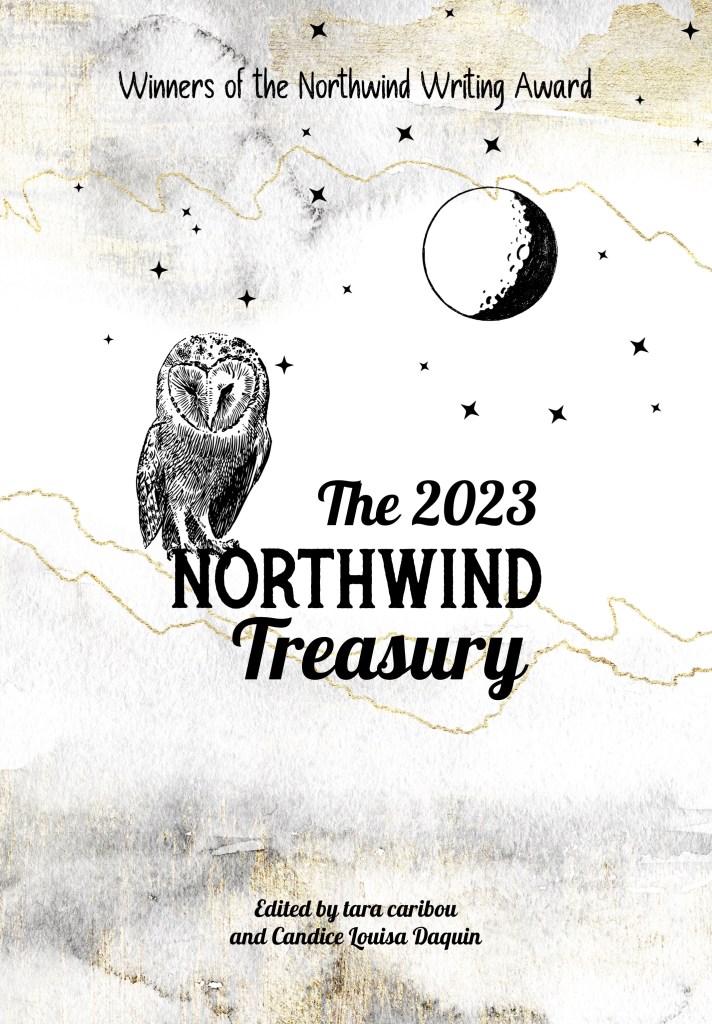
To read The 2023 Northwind Treasury, including Wren’s winning piece, you can purchase it (come December) in paperback on Lulu, Barnes & Noble, or Amazon or as an eBook on Lulu, Nook, Kobo, or Kindle. To see the list of contents and winners, visit our winner’s page.
 Raw Earth Ink