Raw Earth Ink
Spit mixed with dirt – Muddy words flow
Author Spotlight: Rachael Ikins
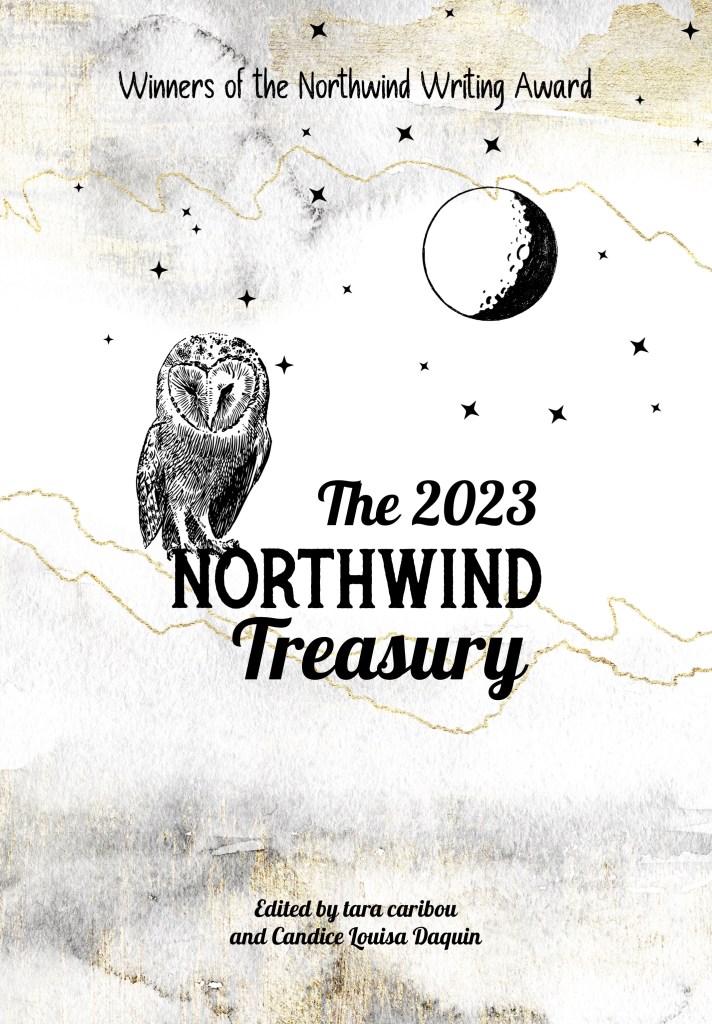
Rachael Ikins won 2nd prize in Prose Poetry in the Northwind Writing Award 2023 for her poem “Ars Poetica, The Skin of this Poem.” It is an honor to feature her Q&A here on Raw Earth Ink as part of our promotion of truly exceptional authors.
Q & A
Candice: In Ars poetica, the skin of this poem you seem to master the genre of vivid and visceral is this a genre you feel speaks for you more than any other? If so, why how do you feel it different from other forms?
Rachael: I gravitate toward vivid 3-D sensory language that incorporates all five senses, and the detail—detail brings the reader into the poem, showing not telling, and that allows a reader to be a participant.
C: How did writing Poetry come to appeal to you and start your journey? Why not prose or other forms? What is it about poetry?
R: my father was dyslexic before that term was used. He had to take a speed reading course to finish college. When it was his turn to read me bedtime stories, as soon as I could read, he had me read him poems from an anthology all soldiers were given during the war, so I think it was that. I also write Prose— short stories novels, essays, reviews, but my heart lives in Poetry. In eighth grade I had a gifted English teacher also a poet who spent a lot of time on poetry and the creating of it, and that was when it really took off for me. She submitted two poems of mine that summer and they were accepted by British Journal. I was 14.
C: What form of writing really speaks to you in terms of your own output and how do you see your writing evolving? In terms of defining the genre you write or do you resist definition when I say form, I mean, defining the style of your writing, if at all.
R: since I began classes during lockdown with Craig Czury, I learned that there are as many types or schools of poetry as there are of art. I discovered that I gravitate towards surrealism and abstract expressionism something I never would’ve thought.
C: As an artist, how important is written word versus painted illustration do they complement each other or are they distinctly different to you?
R: Poetry is something I can’t live without and that has saved my life many times. I love to draw and paint too, but aside from photography which to me is a visual form of a poem I can live without making visual art—there’s too much to learn and I feel the lack of education in both arts.
C: In a doorway, guarded by two crows your description is so vividly written it has so much in such a short piece with so many allusions and references, which really distinguishes your writing. Is this intentional, a style you are drawn toward?
R: I take from even the tiniest, personal experience, memory or observation, and I have an almost eidetic memory. I saw those crows years ago on a vacation on Sanibel Island. The pink barrette I found last year while out walking my dogs. I’m very visual as they say it’s all in the details. Every detail should clarify the poem for the reader. The details are the flesh of the poem.
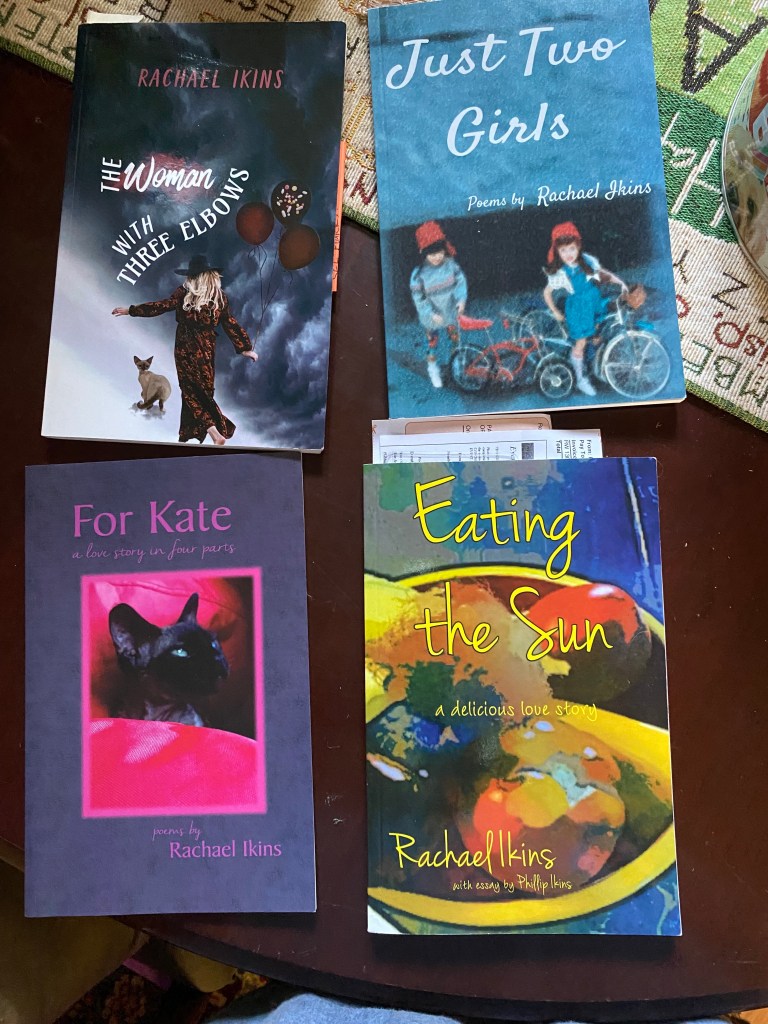
C: You have published with Raw Earth Ink and built a reputation for yourself in many ways, not least because you have a prodigious output, and push yourself time, and again, particularly in your title with The Woman with Three Elbows, you marry description with metaphor and real life in a seamless way, and actually bring the reader into the room with your uncanny ability to illustrate your experiences. That direct but very well crafted approach is very distinctive I find when employed by a writer is often very female. Do you see your writing as having a gender? If not, how do you feel your writing evolves in terms of the way it approaches the reader?
R: I never have thought of my writing as having gender. I have written persona poems from the male point of view. As a matter fact, my Novella, two main characters/protagonist are male. I think authenticity is what counts. One teacher I had recommended eavesdropping when out and about to learn authentic dialogue. Research matters to even in Poetry, a reader wants to be respected and a well-read reader is going to find where you cheated if you didn’t do the proper research.
C: When you compare how you wrote when you began versus now, what are the most palpable differences you observe, and how has that writing shifted?
R: when I began, much of my writing was narrative and like journaling, poetry is not that. Poetry is art. As my current teacher would ask do you want to be a journalist or to make art? I would say my more contemporary poetry has much more, is much more art.
C: What wakes you up in the night gets you up in the morning and demands you write?
R: sometimes I dream or something I was working on in class the day before sparked by something that I saw on the news or while out walking.
C: Where do you feel you struggle the most as a writer, in terms of any aspect of the writing experience to you personally?
R: Keeping that narrator out of the poems and letting the magic in. I was introduced to this concept of magic years ago that at a certain point the poem takes flight into magic, but I didn’t grasp it until last year in a conceptual way. You have observations/details, you ask a question and then there’s magic.
C: What do you get out of other writers, meaning when you read a book you absolutely love, what is it specifically that really pulls you in?
R: character development, a good story that is unexpected and surprises me. I have gotten to a place where I will start a book and have to read the whole thing in one sitting if I am hooked.
C: Which writers have cultivated, and urged to write as well as them, even if differently, and what was it about their writing or stories that encouraged you to begin your journey as a writer?
R: Ann Sexton, Sylvia Plath, Stephen King too many to list here, Jane Smiley, Patricia Smith, Marge Piercy
C: How much does the physicality of your existence influence your writing and what else do you believe drives you as a writer in terms of influence and or tools that you utilize consciously or subconsciously to craft your storytelling?
R: a lot. All five senses. You need those to make it authentic and relatable. I’m a very visual writer.
C: How is the story when it’s with a poem versus prose and why?
R: Prose is narrative like journalism even with flashbacks and other devices. Poetry lays out the detail, engages the senses, then it takes flight into that other realm that is unique to itself. Piercy used to say a poem has a life of its own and has a right to exist outside of you, to live its own life. You tell stories. You inhabit poems. Then you release them. Although I have been told many times my prose is very poetic.
C: When you considered entering the Northwind Writing Award, did this consideration influence what you ended up submitting and why did you choose the pieces you chose?
R: I chose pieces about the poetic process or the nature of poetry a.k.a. Ars poetica, and I chose pieces that included a lot to do with a natural world, which is where my poems most often like to live. I really tried to submit art. I was conscious of the taste of Raw Earth Ink.
C: Is there anything you really despise about writing, a pet peeve or something that disgusts you when you read it?
R: Yes, the politics that can happen. There is enough pie for everyone. It’s just that some don’t see that.
C: How do you envision your writing journey in say five years time what do you hope in terms of where you will find yourself?
R: I hope I have a novel out there and an agent by then, as well as other well-accepted books of poetry and awards.

C: If you weren’t a writer, what do you think you’ve like to do with your life and why?
R: All I ever wanted to be was a writer. I wish I’d had early support, and I wish I had fought for it so I would’ve had a job that sustained me, to free me up to do the writing. In another life I would’ve had human children.
C: Do you think film and plays and theater and dance and all those other art forms, influence writers as much as novels and writing do?
R: definitely. I danced for 15 years. Also exercise makes a difference and is an essential part of my process.
C: What do you make of writers who do MFA programs versus those who do not. This can include courses and workshops also, in other words do you think a writer needs a degree of education or do you believe a writer is born, able to write and becomes able to write through lived experience primarily?
R: I think you are born with talent or gifted. Or not. Undisciplined and under-educated talent can be directionless, so I have always valued learning and improving, and I always strive to better myself. Writing is hard work make no mistake. It is work. The majority of the process is quite unromantic. It is a fantasy that writing of any genre just drops out of you perfect from the get-go.
C: In relation to writing per se, what makes you really really furious these days and what makes you really happy?
R: The current political situation in our country, and in the world and the disregard for the health of the planet. I think, disregarding the health of the planet, which is the only home we have makes me more furious than anything else. We are the only species that continues living in the house that we are burning down and I just don’t understand it. ** What makes me happy? finding bees, toads, bunnies in my garden, harvesting food I grew, that makes me happy, sheltering other living things and making my space a haven for them.
C: Do you consider yourself an Indie writer?
R: I am a professional writer. I dislike that term Indie. To me too many think that is less-than.
C: Your animal family plays an important role in your body of writing. How do they encourage you? Would you be the person you are today if they were not in your life?
R: definitely not. They are everything to me. They are the reason I get up, they are the reason that I push on and they are partly the reason that I write. They inspire me, they make me laugh. They love me unconditionally and in a field that is by nature solitary and lonely, that of the writer, it’s very important to have that validation and that love.

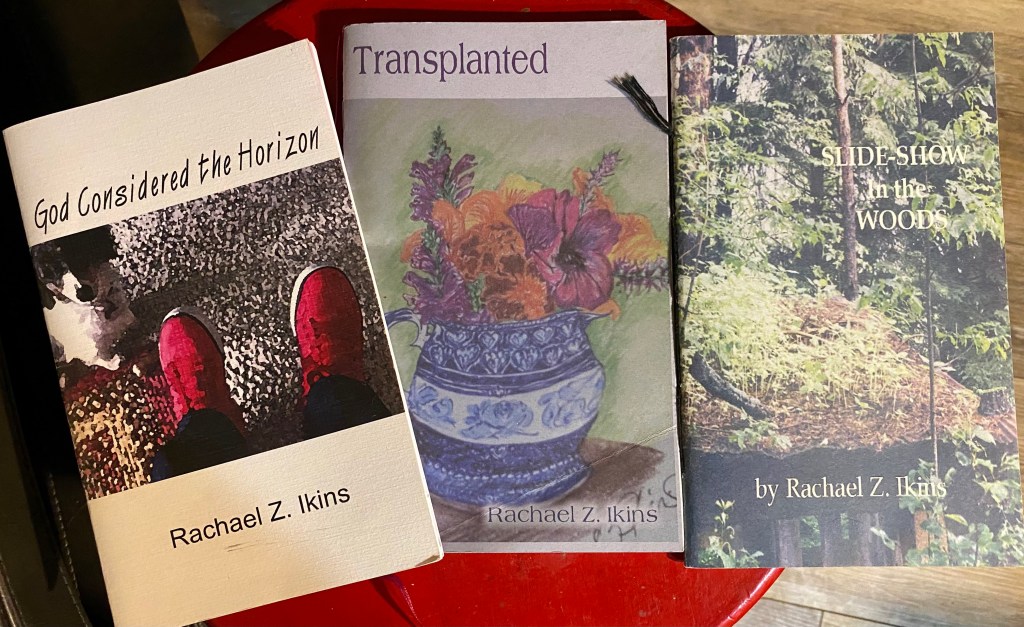
RACHAEL IKINS is a 2016/18 Pushcart, 2013/18 CNY Book Award nominee, 2018 Independent Book Award winner, & 2019 Vinnie Ream & 2019/2021 Faulkner finalist. A 2021 Best of the Net nominee, 2023 Editors Choice Award from Studio B. October 2023 2nd prize and an HM from Northwind Writing Award sponsored by Raw Earth Ink, Alaska.
A graduate of Syracuse University with a degree in Child and Family Studies Ikins worked as a sign language interpreter for deaf students ages K-12 and also as a veterinary technician before devoting herself full time to writing.
Fellowships: Colgate Writers Conferences for poetry (3) and young adult literature.
She founded and moderated the feature/open mic event bimonthly Monday Night Poetry at a sushi Blues 2008-2011.
Honorarium from Finishing Line Press for a week long workshop in Lismore Castle, Lismore, Ireland 2014. While there she worked with Patricia Smith, Jane Smiley, Ethel Rohan and others.
June 2014 she juried into Marge Piercy’s Poetry Intensive workshop, Cape Cod.
Ikins is a Fingerlakes born author/illustrator of multiple books in multiple genres. Her work appears in journals such as the Muddy River Poetry Review, Owl Light, Literary Turning Points,The Mason Street Review, Broadkill Review, Fly on the Wall Press UK, Synkroniciti, the Red Wheelbarrow, S/tick, Dragon Poet Review, Indigo Blue online UK, Cider Press Review, Syracuse Poster Project, The Healing Muse, The Pen Woman Magazine, Avocet, Moonstone Press, anthologies from IndieBlu(e) Press, The Brave (Clare Songbirds Publishing House), Spontaneity Review, Ireland, and many others.
Her visual art and photography have won prizes and have hung in galleries from CNY to Washington DC and appeared on local television stations and on many journal covers. She is a former member of NLAPW and currently of Just Poets. She works as associate/contributing editor at Clare Songbirds Publishing House.
Ikins also spends significant time mentoring emerging poets and helping them achieve published works. She has appeared on the New York Parrot Literary Review YouTube and in other interviews.
Instagram: @rzikins.author.artist
Facebook: Rachael Ikins Books and Poetry
To read The 2023 Northwind Treasury, including Rachael’s winning piece, you can purchase it (come December) in paperback on Lulu, Barnes & Noble, or Amazon or as an eBook on Lulu, Nook, Kobo, or Kindle. To see the list of contents and winners, visit our winner’s page.
 Raw Earth Ink