Raw Earth Ink
Spit mixed with dirt – Muddy words flow
Author Spotlight: J.R. Woods
J.R. Woods won 1st prize in Poetry in the Northwind Writing Award 2023 for his poem “Jukebox.” It is an honor to feature his Q&A here on Raw Earth Ink as part of our promotion of truly exceptional authors.
Q & A
Candice: When you compare how you wrote when you began and now, what are the most palpable differences you observe in how that writing has shifted?
J: When I began writing, the scope of my lived experiences was much more narrow than it is today, and as such, there was a higher degree of fictionality. Today, even when a piece is fictional, there is a certain amount of reality behind the words—I can see the story holding true for somebody, anybody. I know there is a reader out there resonating with the words.
C: Where do you feel you struggle the most as a writer, in terms of any aspect of the writing experience to you personally?
J: I struggle most with productivity. I have ADHD, and I find it extremely difficult to focus on my work. I can switch interests in the middle of a thought. There are so many aspects of ADHD that make writing a struggle. On a regular basis I write very few words, and then I go through a period of hyperfocus and crank out tens of thousands. Sometimes, I don’t write a single word for weeks. There are so many prolific writers out there who are able to crank out several books a year—I marvel at the thought.
C: What do you get out of other writers and how? Meaning, when you read a book, you absolutely love, what is it specifically that really pulls you in?
J: The thing that really draws me in is the quality of the words—The diction. The syntax. The repetition of sound. The ability to conjure an image in the mind of a reader. There is a certain quality to great writing that transcends individual preference.
C: How different is a story when it’s within a poem versus prose and why?
J: Poetry often demands more work to be done on the part of the reader in order to comprehend the text—There are fewer words, and thus, so much more is left unsaid. As difficult as it is to interpret complex prose, it is even more difficult to interpret complex poetry. I enjoy prose poetry and flash fiction the most because it offers the floral language and brevity of poetry as well as the continuity and detail of prose. On a side note, I’ve found that far too many readers of poetry associate the author with the narrator, or speaker or subject of a poem—This is a terrible habit to fall into. The author of a piece is not the narrator or subject unless specifically stated by the author. People read first-person prose and can generally separate the author from the narrator, but this is less true with poetry. So many readers automatically assume that the poet is writing about themselves, that the story they’re telling is a true story, and one that directly involves the author. All writing should be viewed as fiction unless the author themselves claims it to be true. A well-told fiction story holds just as much weight as a well-told true story. The story can be true for a reader and fictional for the author.
C: When you considered entering the Northwind Writing Award, did this consideration influence what you ended up submitting and why did you choose the pieces you chose?
J: This was only the second time I worked up enough courage to submit my writing for publication. I chose four pieces to submit that I felt represented me as a writer. I chose four pieces that I was proud of.
C: What other factors come into play when you write? Anything …
J: I usually aim to provoke thoughts in a reader. I want them to question. I want them to debate with themselves, or the narrator, or anyone else. I believe that all art should be felt and not merely observed. I want a reader to see the text as more than just words on a page.
C: If you were describing yourself to someone else, anonymously and they did not know you, what would you want them to know about you?
J: To a person who did not know me I would describe myself as a monkey with a keyboard. I do not claim to have the answers. I do not claim to know any secrets. My needs in this life are very few. I am most content when I am alone in the forest for days or weeks at a time. I am a simple observer of human nature.
C: Do you think film and plays and theater, music and dance and all those other forms of art, and entertainment, influence a writer as much as novels and writing do?
J: I believe that we take our combined life experience into every new moment, and each happening influences the way we perceive the next. As such, writing influences no more or less than anything else.
C: What do you make of writers who do MFA programs versus those who do not? In other words, do you think a writer needs a degree of ‘education’ or do you believe a writer is born able to write or becomes able to write through lived experience primarily?
J: I do think there is some amount of innate talent that comes into play with great writing. Not everyone has the ability to tell a strong story or use words to evoke an emotional response. And lived experience definitely adds to the believability of a piece. Of course it is possible to write from a perspective you have never experienced firsthand. You can draw upon things you’ve witnessed. You can imagine how something would be or how someone might feel. But this can lead to a piece not feeling genuine or believable. With regards to education I believe that it is perfectly possible to write well without a formal education. A formal education will introduce you to great published works, new techniques, new perspectives and builds skills by allowing a teacher and peers to comment and criticize. However, these things are all possible without a formal education. One can read a lot of books, read reviews and critiques, study how-to books such as Stephen King’s “On Writing,” and find a group of people to share work in all stages with. A formal education puts all of that in one place and hands it to you. But lack of a formal education does not mean no education has taken place.

J.R. WOODS is a Pacific Northwest-based writer of poetry and fiction. His work examines society and human nature through a unique and satirical dark lens. He is of the belief that art is meant to be experienced and felt, not merely observed. While the topics are often quite heavy, he strives to provoke profound thoughts in his readers.
Instagram: @j_r_woods_
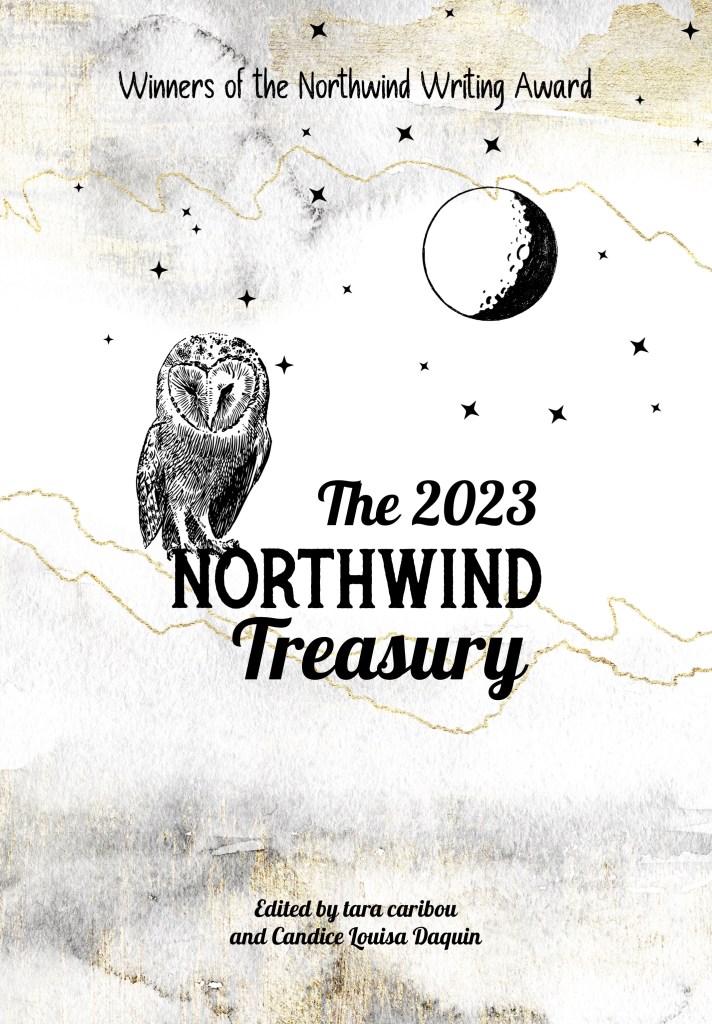
To read The 2023 Northwind Treasury, including J.R.’s winning piece, you can purchase it in paperback on Lulu or as an eBook on Lulu. To see the list of contents and winners, visit our winner’s page.
 Raw Earth Ink