Raw Earth Ink
Spit mixed with dirt – Muddy words flow
Author Spotlight: Laurinda Lind
Laurinda Lind won 1st prize in Poetry in the Northwind Writing Award 2024 for her poem “Year One.” It is an honor to feature her Q&A here on Raw Earth Ink as part of our promotion of truly exceptional authors.
Q & A
Candice: Laurinda, firstly thank you for your beautiful submission. What stood out to the judges was the beauty of your writing and the terrible sorrow of your subject. Many times a subject can win because of its powerful theme, but the writing itself isn’t as strong. We all felt that regardless of subject, your writing stood on its own. However the subject of such profound loss is also a universal theme many of us can deeply relate to. What was your thought when you submitted this deeply personal poem to the competition?
Laurinda: Thanks for your kind words. Of hundreds of poems, I chose intuitively for submission to the contest (I may even have dowsed on a few). I haven’t sent much writing out this year, because I moved to a different town and am swimming in too much newness. But since Northwind is a newer contest, it inspired me to try for a reset.
CD: Was it challenging to share such a deeply personal poem publicly? Or was this in some way, cathartic? I would imagine it’s a vulnerable thing to share such an intimate moment of your life and how challenging that would be?
Laurinda: In some ways, even though it is an older poem, this one keeps echoing out of me as if I am still writing it. The devastation of that time comes back with its ironies — sacrifice under the trees, black-clad witnesses, a kinder season after it’s too late. Every time, I feel grateful there was a way to vent it.
CD: Can you talk to us about writing this poem and how you began writing out your grief in this way?
Laurinda: My son died on Martin Luther King Day, a school holiday (and his school nickname was Luther), shocking his family (father and four siblings) and circle of friends. All these years I thought his death accidental, but just this spring I learned it wasn’t. He was a terrific student and funny, but introverted. On the day of the cake and crows, I felt I was releasing him to the elements.
CD: Did you find your writing changed after such a profound loss? And how did writing play a part in working through this loss, especially when it’s such a life-changing event that can never really be “worked through” like other types of grief?
Laurinda: Well, I changed for sure, we all did. My poems afterward got grittier, I think; then other badness ensued. “Year One” came two-thirds of the way through an eighteen-year silent period where I wrote poems but rarely showed them to people. Then a breakthrough, and poetry submission became an anodyne to the difficult world.
CD: The imagery is gorgeous in your poetry, where do you get the influence for your images and metaphors?
Laurinda: Thanks again. If you look with your inner eye, your surroundings themselves supply the imagery, and the poem becomes like dream analysis — the subconscious mind puts symbols in front of us all day long, but most of the time we’re too lost in the weeds to see them.
CD: What power does poetry play in the translation and processing of grief in your opinion?
Laurinda: Thank God poetry is available as a valve to take some grief out of us through a hole it opens in us. Sometimes it feels as if we died, too, but after the poem comes through, we find out we are still alive.
CD: When you write, do you find a catharsis in writing out an experience, even such a painful one?
Laurinda: Writing about pain’s a way of being a survivor. Even, as I think I wrote in a poem (about Sylvia Plath), when you name what hurts, that enables joy, and asserts what’s hard hasn’t been meaningless. I do feel that.
CD: In your opinion, how do you think people can benefit from reading grief poetry or poems on the subject of loss and grief? I, for one, find them very important in the canon of writing, but I’d love to know your perspective on this.
Laurinda: I’ve known many people turned off by poetry in school because of the formulaic way it came at them. Despite this, people who expect poetry to be strictly metered and rhymed don’t know what to make of free verse. It’s when they notice that it’s saying what they’ve been holding inside that the gate opens and they walk into the words. The grief-affected are a very big club, and their commonality cuts through a lot of BS.
CD: Do you believe grief has powerful imagery that goes hand-in-hand with the experience, so when you think of grief, you also think of the images that accompany it, such as the snow, and the crocuses, and all the things you recall that seem to be forever connected to that time of grief?
Laurinda: I think the imagery carries us through it, even for non-artists. At the risk of sounding repetitive, it’s a place to keep yourself while you go on recovering for the rest of your life. I have already said I didn’t know for years that my son was a suicide; this spring, his younger brother followed suit. He too was smart/ deep/ conflicted. So I have to find more boats to put that ache into.
CD: As a reader of poetry, what do you like and dislike about poetry and why?
Laurinda: A good poem is like an available alternate existence, where a reader suddenly realizes, “Oh. This, too, is who I am.” Probably a reason for all the different poem varieties is that people have so many different needs. I don’t always “get” very academic poetry, but I’ll bet there are those who simply light up from it.
CD: Do you find “modern” online poetry varies from the more traditional published (print) poetry in terms of length and subject and how do you feel about this?
Laurinda: There’s a place for form and format, and writing in traditional form pulls things out of you that open-form poetry won’t. But rhyme needs to be unexpected, and to illuminate. I don’t think there are any wrong subjects.
CD: As a writer, was there a time when the grief was too powerful to find you could write “through” that grief, did you have to wait before you could write?
Laurinda: That’s where I am now, waiting.
CD: We all felt your last line “it just can’t be alive enough” slayed us, and the very potency of that in relation to the loss of life, was such a powerful image and ending. Many poems struggle to “end” themselves and you wrote this as if you knew exactly how to end it, before you’d got there. Was this a poem that flowed out of you or more one you planned out consciously?
Laurinda: This poem just climbed right up out of my throat and out through a dollar-store black pen, because it was a place I could stash that strange, lonely hour.
CD: As an award-winning poet and writer, do you feel connected to that identity or are you someone who writes without really believing you are a writer per se? In other words, do you have Imposter Syndrome as a writer, or are you quite comfortable with the idea of being a writer? And if so, what does “being a writer” mean to you?
Laurinda: While submitting feels like being part of the conversation, composition is meditative or is like psychoanalysis or something. What’s in all the dark cupboards? You’ll find out. I don’t think of myself as a writer until people start asking questions about how I spend my time. Also, it didn’t exactly discourage me that I got to fly from the U.S. to London to read a single poem. That day I felt like a writer.
CD: Please share any other aspects to your poem “Year One”, and what brought you to submit it to Northwind, that you believe readers would benefit from knowing about?
Laurinda: Advice to readers: don’t just read. Write. And don’t give up on a poem, ever. Every time you go back to a problem poem you’ll see something that needs to go out or come in (as long as you keep reading poems that found a place before yours did). “Year One” sat around for a long time before I first sent it to a magazine that wasted no time in rejecting it, and it racked up a little heap of subsequent rejections. But I kept casting it out until it caught somewhere. It’s also the last poem in my new chapbook.

Author bio: Laurinda Lind lives in New York State’s North Country, where she worked as an adjunct English teacher and caregiver. Her poetry and fiction appear in over 400 literary journals, including Atlanta Review, Blueline, Comstock Review, Constellations, The Cortland Review, Guesthouse, New American Writing, Open: Journal of Arts & Letters, Radius, SmokeLong Quarterly, Spillway, and Stand. She is a Pushcart Prize and Best of the Net nominee and placed first in poetry contests for the Keats-Shelley Prize, the Foley Poetry Award, and the Peggy Willis Lyles Haiku Contest.
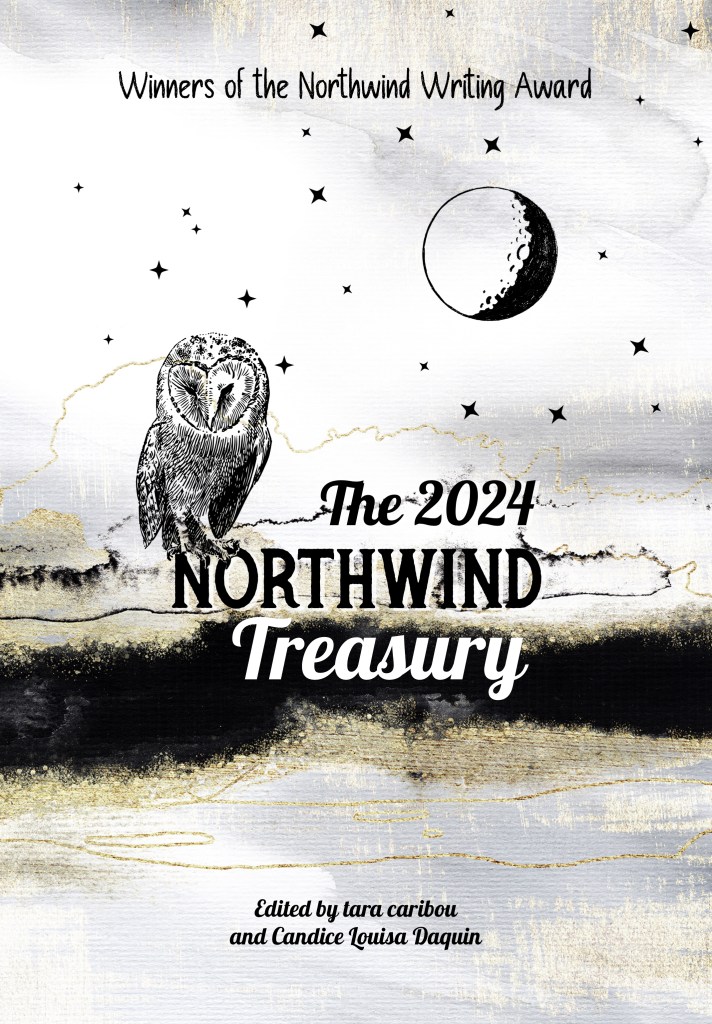
To read The 2024 Northwind Treasury, including Laurinda’s winning piece, you can purchase it in paperback on Lulu, Barnes & Noble, or Amazon, or as an eBook on Kindle. To see the list of contents and winners, visit our winner’s page.
 Raw Earth Ink