Raw Earth Ink
Spit mixed with dirt – Muddy words flow
Author Spotlight: Mei Davis

Mei Davis won 1st prize in Fiction in the Northwind Writing Award 2024 for her short story “Like A Pearl.” It is an honor to feature her Q&A here on Raw Earth Ink as part of our promotion of truly exceptional authors.
Q & A
Candice: Mei, thank you so much for your submission. What stood out to the judges was the raw beauty of your writing, from the title, to the gradual revealing of your incredible story. “Like a Pearl” has stayed with me long after reading. Can you describe to us your process of writing this story and what it means to you?
Mei: Usually I don’t recall the particulars of writing a story, but in this case I remember very vividly the process. The idea had been stewing for some time in my mind, and I finally got a crack at it during a weekend getaway with my husband at a local beach town. While my writing is usually a trickle, this story was more like a flood, and poured out in a couple of days.
CD: Who are your influences in terms of writing if any? If they are not fiction writers, what influences you in your writing process?
Mei: Anything I read bears some influence on my writing. I read very broadly and whatever the genre, whether humor or science fiction or mystery or non-fiction, I am constantly on the prowl for effective means of conveying emotion, tone, subtlety, action, etc. My favorite writers include Jane Austen, Laura Hillenbrand, Suzanne Collins, and Agatha Christie.
CD: I have read stories of immigration and people coming to countries through all means of transport, and the horrors they encounter. Was there a personal aspect to your story? As a fellow immigrant I am interested if this was purely fictional or there was some lived-or-second-hand experience that influenced you in some way?
Mei: I grew up immersed in the Asian-American community of Southern California, and while I don’t have direct familial connection with the Vietnamese “boat people,” I have several friends and in-laws whose families were forced to flee post-war and experienced many of the traumas described in the story. Their accounts, and my own research on the topic, were highly influential.
CD: As an immigrant, I was especially moved by the rendition of this experience and particularly felt the story was carried even further by your selection of the narrator and that narrator being a child. Did you intend from the outset to do this? What was your purpose in choosing a child narrator?
Mei: Through parenthood, I was able to observe firsthand the viewpoint of (three!) children, and how often outside influences are buffered by their profoundly singular focus. This was the perspective of Thi. She didn’t necessarily understand why things were happening, only what was happening, and how those happenings affected her personal bubble. The broader socio-political conflicts, symbolized by the sound-bytes of the adults around her, were simply babble that had no bearing on what was most troubling in her insulated world: the fact her mother wouldn’t hold her like she used to.
And yet, is the inward struggle with feeling displaced as a second child less compelling than being displaced from a home over political conflict? In some ways, it is even more compelling, for while the latter has more far-reaching consequences, the former speaks to a more universal emotion: loss. And so, with the political baggage swept away, we are immersed in the raw emotion of the child, which in many ways makes the more nuanced emotions of the adults, with whom we might share no similarities or experiences, all the more relatable.
CD: People can read such experiences from the safety of their armchair and say they are moved, but do you think fiction can change people’s minds or opinions about big subjects like immigration and cruelty?
Mei: Narratives often have an advantage over non-fiction because they are designed to be entertaining. For many, it is easier to pick up a novel than a newspaper, and in that way I do believe fiction can be a starting point for understanding. But I think true and effective change doesn’t live in fiction, but in doing the hard work of going out and talking to different people, listening to different viewpoints, hearing the real stories from those who have lived them.
CD: I felt there were many influences here, not least the idea of sewing all you owned into a toy, and yet, it was not obvious from the start that this would be the ‘sacrifice’ to save the little girl’s mother from more abuse. In your opinion, what is the significance of this?
Mei: Again, this touches on the dichotomy between the perspective of Thi vs the adults around her, namely her father. A child giving up her doll is no less compelling than a man giving up his fortune. In their respective perspectives, the stakes are the same. Thi had no concept of the worth of the “marbles” inside of Chau doll. But to her, Chau doll had immeasurable worth. To her, Chau doll was priceless, its value eclipsed only by one thing, the most valuable thing, in her eyes. Once again, the perspective of the child brings a certain clarity to the emotions, to the concept of sacrifice, that might otherwise be clouded with the anxieties and pragmatism of adulthood. Thi gave up her most precious things without a second thought. Would we have done the same?
CD: Do you write in one style or play with varied styles and genres?
Mei: Like my reading habits, my writing is very broad and spans almost every genre. I ascribe to the idea that it is harder to make someone laugh than it is to make them cry, and make occasional forays into humor. I’ve also written a fair number of speculative stories. As a carryover from my fanfic days, I also enjoy writing adaptations of folk tales and myths.
CD: Tell us a little about what brought you to becoming a writer, what your story is there, and how it evolved from the time you began writing, until now?
Mei: I wrote on and off from a young age, but really only began writing extensively as a young adult. Like a lot of writers, I cut my teeth in the fanfic world, playing around with various points of view, tenses, genres, styles. It was a great training ground to practice the fundamentals of writing without getting bogged down with the painstaking process of plotting and originating ideas. Once I had grown sufficient skills as a writer in general, I moved on to original fiction.
CD: What were the crux messages you were conveying in your story? Do you feel there was anything you’d have liked to say more about, but didn’t because of length restrictions or other reasons?
Mei: In the last line of the story the boat is heading towards the coastline, and it is there, in the hope of a new horizon, where an uncomfortable truth lives.
As descendants of immigrants, my brothers, my in-laws, my friends, myself and many others like us, would not exist without the upheavals and traumas that launched our antecedents from home countries. Our lives have risen out of the ashes of their broken pasts, a bittersweet reminder for me to be compassionate, to be humble, and above all, to be thankful.

Author bio: A former Angeleno, Mei Davis currently resides in the cold wilds of Metro Detroit with her husband, children, and an oft-neglected laptop. She has previously been published by prairiefire, Translunar Traveler’s Lounge, Sans Press, Parsec Ink, and has an upcoming publication with Kinsman Quarterly.
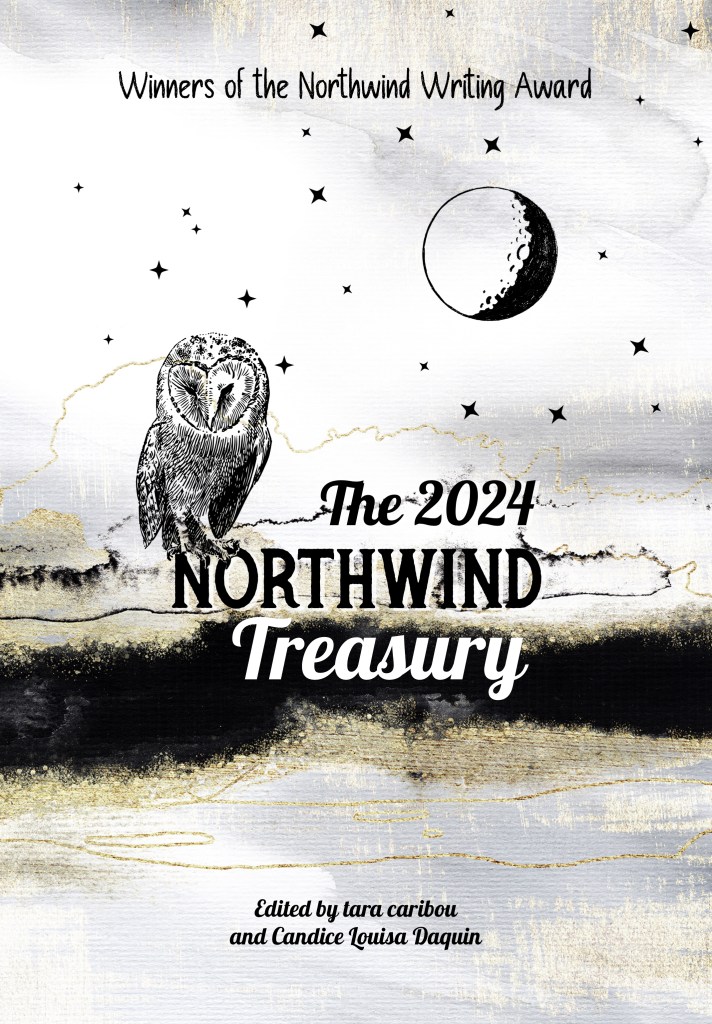
To read The 2024 Northwind Treasury, including Mei’s winning piece, you can purchase it in paperback on Lulu, Barnes & Noble, or Amazon, or as an eBook on Kindle. To see the list of contents and winners, visit our winner’s page.

 Raw Earth Ink